

Perfectly Competitive Market Demand Curve
Toll and Revenue
Each firm in a perfectly competitive market is a price taker; the equilibrium price and industry output are determined by demand and supply. Figure 9.one "The Market for Radishes" shows how demand and supply in the market for radishes, which we shall assume are produced under conditions of perfect competition, make up one's mind total output and price. The equilibrium price is $0.40 per pound; the equilibrium quantity is x million pounds per month.

Figure 9.1 The Market for Radishes. Cost and output in a competitive market are determined by demand and supply. In the market for radishes, the equilibrium price is $0.xl per pound; 10 one thousand thousand pounds per month are produced and purchased at this price.
Because it is a cost taker, each house in the radish industry assumes information technology tin sell all the radishes information technology wants at a toll of $0.40 per pound. No affair how many or how few radishes it produces, the house expects to sell them all at the market price.
The assumption that the firm expects to sell all the radishes it wants at the market price is crucial. If a firm did not expect to sell all of its radishes at the market price—if information technology had to lower the price to sell some quantities—the business firm would not be a cost taker. And price-taking behavior is central to the model of perfect competition.
Radish growers—and perfectly competitive firms in full general—have no reason to accuse a price lower than the market price. Because buyers have complete information and because nosotros presume each firm'southward product is identical to that of its rivals, firms are unable to charge a cost college than the marketplace toll. For perfectly competitive firms, the toll is very much similar the weather: they may mutter about it, but in perfect competition at that place is zippo whatever of them tin practise about it.
This video explains how the market place supply and need curves determine the price of a good, and why firms in a perfectly competitive market are price takers.
Total Acquirement
While a business firm in a perfectly competitive market has no influence over its price, it does determine the output information technology will produce. In selecting the quantity of that output, one important consideration is the revenue the firm will gain by producing it.
A house'due southtotal acquirement is found past multiplying its output by the toll at which it sells that output. For a perfectly competitive business firm, total revenue (TR) is the market cost (P) times the quantity the business firm produces (Q), or
TR = P 10 Q
The relationship between marketplace cost and the firm's full revenue curve is a crucial ane. Panel (a) of Figure ix.2 "Total Acquirement, Marginal Revenue, and Average Revenue" shows total revenue curves for a radish grower at three possible market prices: $0.xx, $0.40, and $0.60 per pound. Each total revenue curve is a linear, up-sloping curve. At any price, the greater the quantity a perfectly competitive firm sells, the greater its total revenue. Notice that the greater the price, the steeper the full revenue curve is.
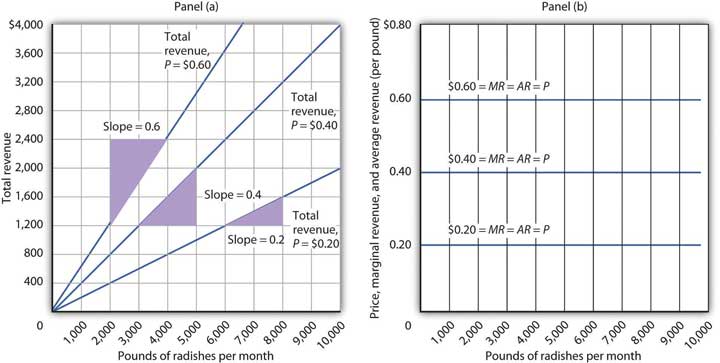
Effigy 9.2 Total Acquirement, Marginal Revenue, and Average Acquirement. Panel (a) shows different total revenue curves for three possible market prices in perfect competition. A full revenue curve is a straight line coming out of the origin. The slope of a total revenue bend is MR; information technology equals the marketplace price (P) and AR in perfect competition. Marginal revenue and average revenue are thus a single horizontal line at the marketplace price, as shown in Console (b). There is a different marginal revenue curve for each toll.
Marginal Revenue, Price, and Need for the Perfectly Competitive Firm
We have seen that a perfectly competitive firm's marginal acquirement curve is simply a horizontal line at the market price and that this same line is also the business firm'due south average revenue curve. For the perfectly competitive firm,K R = P = A R. The marginal acquirement bend has another meaning too. It is the demand curve facing a perfectly competitive firm.
Consider the instance of a single radish producer, Tony Gortari. We presume that the radish market is perfectly competitive; Mr. Gortari runs a perfectly competitive firm. Suppose the marketplace cost of radishes is $0.twoscore per pound. How many pounds of radishes can Mr. Gortari sell at this cost? The answer comes from our assumption that he is a toll taker: He can sellany quantity he wishes at this cost. How many pounds of radishes will he sell if he charges a price that exceeds the marketplace price? None. His radishes are identical to those of every other firm in the market place, and anybody in the market place has complete information. That means the demand curve facing Mr. Gortari is a horizontal line at the marketplace price as illustrated in Figure 9.3 "Price, Marginal Acquirement, and Demand". Notice that the bend is labeled d to distinguish information technology from the market demand curve, D, in Figure ix.1 "The Market for Radishes". The horizontal line in Figure ix.3 "Price, Marginal Revenue, and Demand" is likewise Mr. Gortari'southward marginal revenue curve, MR, and his average revenue curve, AR. It is also the market price, P.
Of course, Mr. Gortari could charge a cost below the marketplace price, merely why would he? We presume he tin sell all the radishes he wants at the marketplace price; in that location would be no reason to accuse a lower price. Mr. Gortari faces a demand curve that is a horizontal line at the market price. In our subsequent analysis, we shall refer to the horizontal line at the market price simply every bit marginal revenue. We should remember, all the same, that this aforementioned line gives us the market place price, average revenue, and the need curve facing the firm.

Figure 9.iii Cost, Marginal Revenue, and Need. A perfectly competitive firm faces a horizontal demand bend at the marketplace cost. Hither, radish grower Tony Gortari faces demand curve d at the market price of $0.xl per pound. He could sell q1 or q2—or any other quantity—at a toll of $0.twoscore per pound.
More generally, nosotros can say thatany perfectly competitive firm faces a horizontal need bend at the market price. We saw an example of a horizontal demand curve in the module on elasticity. Such a curve is perfectly elastic, meaning that whatever quantity is demanded at a given price.
Note that Figure 9.1 shows the market place (and demand bend) for aperfectly competitive industry and Figure 9.3 shows the need curve for a perfectly competitive firm.
This video demonstrates how average revenue equals marginal revenue, which equals price in a perfectly competitive market place.
Self Check: Perfectly Competitive Firms and Industries
Answer the question(s) below to encounter how well you understand the topics covered in the previous section. This short quiz does not count toward your grade in the grade, and you tin can retake information technology an unlimited number of times.
You'll have more than success on the Self Check if you've completed the two Readings in this section.
Utilise this quiz to check your understanding and decide whether to (1) report the previous section further or (2) move on to the next section.

Perfectly Competitive Market Demand Curve,
Source: https://courses.lumenlearning.com/suny-microeconomics/chapter/price-and-revenue-in-a-perfectly-competitive-industry-and-a-perfectly-competitive-firm/
Posted by: pricebeggersewen.blogspot.com
0 Response to "Perfectly Competitive Market Demand Curve"
Post a Comment